
Ashland County Warrant Records in Ashland
Ashland County Warrant Records are often checked through a combination of the sheriff's office, the clerk of circuit court, and the statewide WCCA portal. If you are trying to find out whether a warrant is still active in Ashland, the courthouse at 201 West Main Street gives you a place to ask in person, while the sheriff's office can verify what is currently being served or tracked. That split is helpful because the public court record, the sheriff's enforcement record, and the paper file do not always look the same at the same moment. A good search usually starts online and then moves to the office that can confirm the current status.
Ashland County Overview
Ashland County Warrant Records at the Sheriff's Office
The Ashland County Sheriff's Office is at 220 East Chapple Avenue, Ashland, WI 54806, and the phone listed in the research is (715) 682-7023. The office handles active warrant inquiries by phone and in person, which is useful when you need something more current than an online docket. The sheriff's office also works with jail booking records, civil process, and coordination with municipal police departments, so it is often the best source for confirming whether a warrant is still live in the field.
Before you call, check the public Wisconsin Circuit Court Access portal. That statewide index is the easiest way to see whether a case is on the court calendar, whether a warrant status flag appears, and whether a docket entry gives you enough detail to move forward. Because WCCA is a statewide index, it is especially helpful when you are trying to compare what the sheriff knows with what the court has entered. If the case was recently updated, it may take a little time to appear everywhere.
The Ashland County WCCA portal at wcca.wicourts.gov is the first online checkpoint for the image that follows.
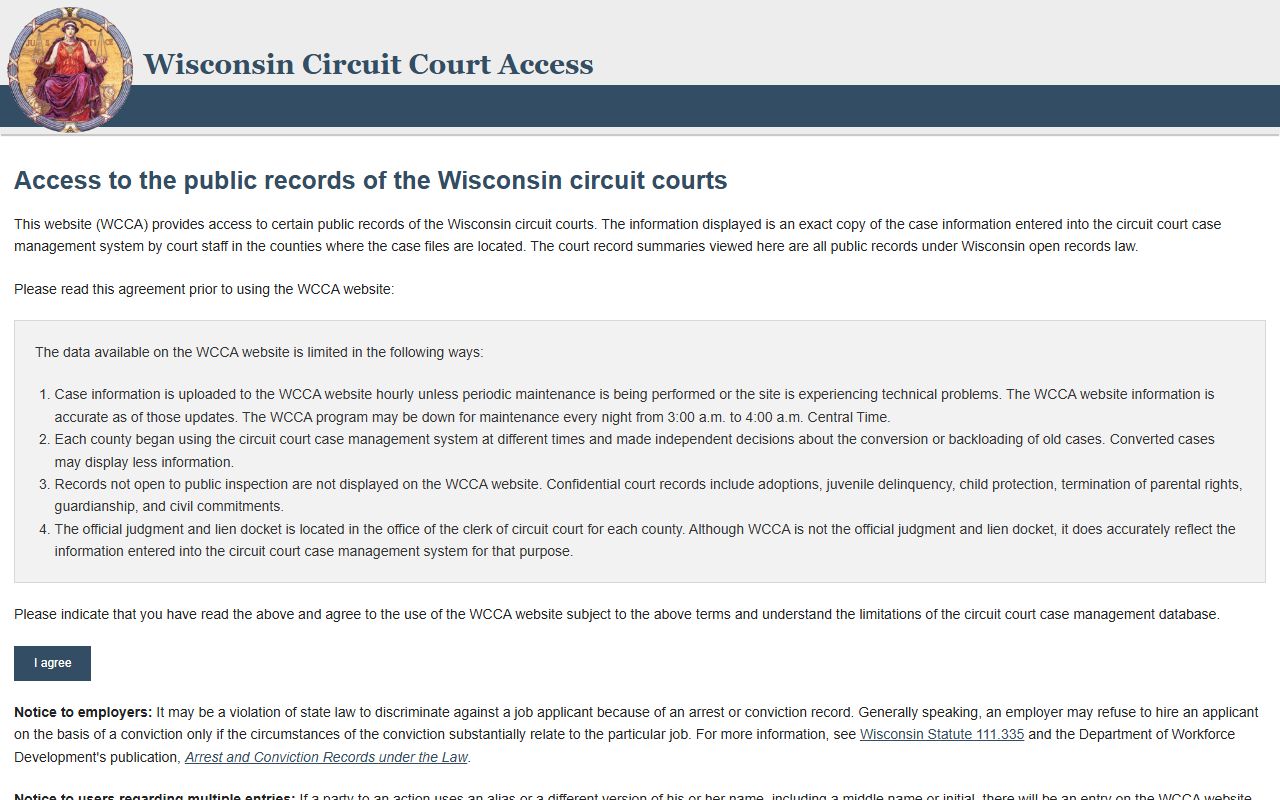
The online view is not a substitute for a live confirmation from the sheriff, but it does help you narrow the case and avoid asking for the wrong file. That matters in Ashland County because the research points to several categories of warrant work, including arrest, bench, search, and civil matters, all of which can show up differently depending on which office last handled the record.
How to Search Ashland County Warrant Records
Ashland County Warrant Records can be searched in more than one way, and the best route depends on what you already know. If you have a name or case number, WCCA is the fastest public tool. If you need the current status of a warrant, the sheriff's office can verify it by phone during business hours. If you want to inspect the file or get a copy, the clerk of circuit court is the office that controls the court record.
The courthouse public terminals at 201 West Main Street are especially useful because they give you the same basic court index that online users see, but with the benefit of staff nearby if the case number or spelling needs correction. The county research also notes that WCCA may show warrant status fields such as active, recalled, quashed, or executed, which means the portal can help you tell the difference between an old case note and a live warrant. Even so, not every sealed, juvenile, or otherwise confidential item appears online.
For a clean Ashland County Warrant Records search, start with these details:
- Full legal name or known alias
- Case number if you have it
- Date of birth for the subject of the search
- Whether the issue came from a criminal, traffic, family, or civil case
The county's search pattern is especially practical when a warrant is tied to a missed court date or a support or family matter. In those situations, the court file and the sheriff's record need to be read together, because one office may show the docket history while the other is the office actually handling service or enforcement.
Ashland County Clerk of Circuit Court and Warrant Records
The Ashland County Clerk of Circuit Court is at 201 West Main Street, Room 102, Ashland, WI 54806, with phone number (715) 682-7016 and email publicrecords@co.ashland.wi.us. This office is the records custodian for the court file, so it is the place to go when you need copies, a records request form, or a more complete paper trail behind an Ashland County Warrant Records search. Office hours are Monday through Friday, 8:00 AM to 4:30 PM.
The clerk's public records request form asks for a detailed description of the records you want, contact information, and whether you want to inspect records in person or receive copies. That matters because a Warrant Records request can mean different things in practice. Sometimes you only want a status confirmation. Other times you need a judgment, a writ of execution reference, or a document that explains why a warrant or warrant-like entry appears on the docket. The clerk is the office that can usually separate those pieces for you.
Ashland County also highlights language access materials, restraining-order guidance, judgments and writ information, and forms through its court resource channels. That tells you a lot about how the county expects people to use the record system: as a working courthouse record, not just as a search result. If the online index gives you a lead but not the full story, the clerk's office is the place to ask for the file that sits behind the search result.
For copy requests, expect the county to follow Wisconsin copy-fee rules, which generally allow charges for reproductions while preserving inspection access. That distinction is important if you only need to read a document on site. It is also important if you are trying to decide whether to request an electronic copy, a certified copy, or simply a docket review.
Ashland County Law Library Help for Warrant Records
The Ashland County law library page at the Wisconsin State Law Library county directory is a practical follow-up when an Ashland County Warrant Records search touches more than one office. The directory pulls together county contacts that are easy to miss if you only search the court index.
The Ashland County directory at wilawlibrary.gov/topics/county.php?c=Ashland is the legal-contact page shown in the image that follows.
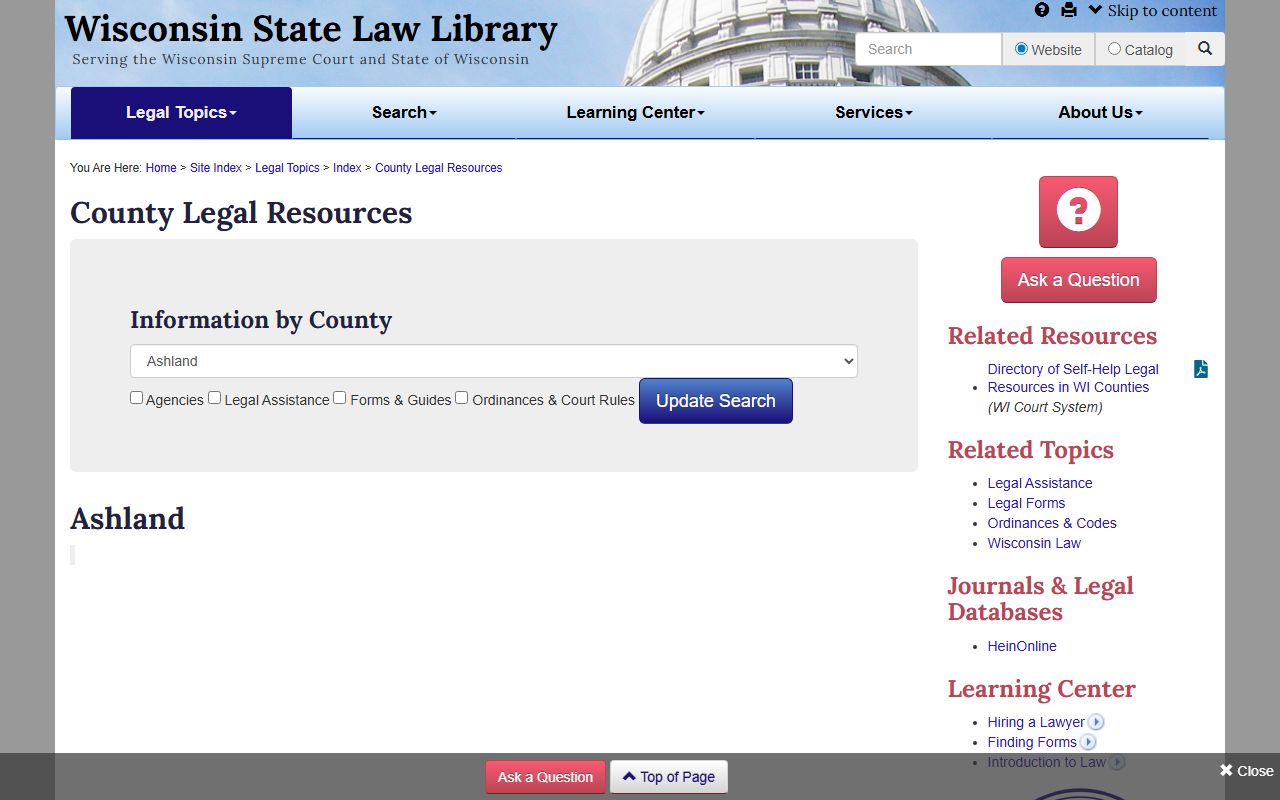
The county page links to the Child Support Agency, District Attorney, Corporation Counsel, Family Court Commissioner, Register in Probate, and Register of Deeds. Those contacts matter because a warrant search can be tied to support enforcement, a missed family hearing, a probate-related issue, or another court action that is broader than the sheriff's active-list response. Instead of guessing which office controls the next step, the directory gives you the county map.
The same law-library ecosystem also points people toward language access materials, legal assistance referrals, court forms, and self-help options. If you are trying to understand how a warrant-related docket entry fits into a larger case, that is often more valuable than a single yes-or-no answer from a search portal. For Ashland County Warrant Records, the county legal directory is the bridge between the public record and the office that can explain the record's next move.
Wisconsin State Warrant Records Resources for Ashland County
Wisconsin's statewide tools fill in the parts of Ashland County Warrant Records that the county office pages do not always show. The statewide public index is WCCA, while the broader court system at wicourts.gov provides forms, court contacts, and eFiling access. The Wisconsin State Law Library also keeps useful legal references at Arrest & Bail Resources and Search and Seizure Resources.
Those state pages help explain why a warrant can appear in one place and not another. Chapter 19 governs access to public records, Chapter 968 covers the beginning of criminal proceedings and warrants, and Chapter 969 covers release conditions and bail. Once you know that framework, the county search becomes easier to interpret. A WCCA record is a lead, the sheriff can confirm current status, and the clerk can produce the paper file when you need proof or context.
For most people, that is the best order in Ashland County: start with WCCA, confirm with the sheriff, and then use the clerk or law library if the record needs a deeper explanation. That keeps the search practical and avoids reading too much into a single line in the public index.